


MAISON BONNEFOY
"Vannes" Recycled Yarn Throw Blanket, France
"Vannes" Recycled Yarn Throw Blanket, France
 Free shipping over $200
- Ships within 3–5 business days
- 14-day returns on in-stock items

Almost Claimed — Only 2 Remaining
Sold — view similar- Ships from our shop in New Preston, Connecticut
Couldn't load pickup availability


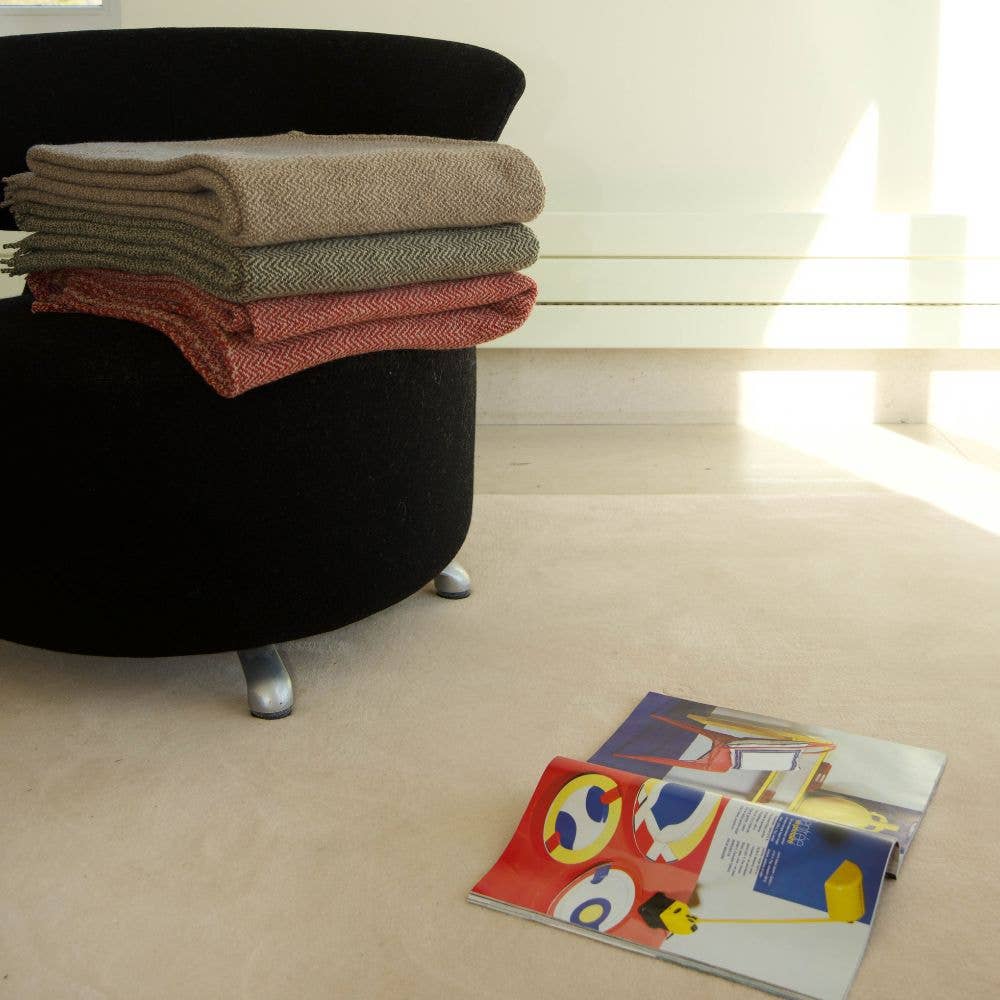
A throw knitted from 100% yarn reclaimed from used sweaters, 140 × 180 cm. Made at Maison Bonnefoy in the Auvergne.
This is the only throw of the three with no virgin fibre in it, and the most interesting of the three to own. Mechanically recycled wool is made by stripping old knitwear by hand and sorting it by colour, then washing and fraying it back to loose fibre and respinning that into yarn. Sorting by colour is the whole trick: because the colour is already in the fibre, the new yarn does not need to be dyed — which saves the water, the chemicals and the carbon that dyeing accounts for, and that is where most of a textile’s environmental cost actually sits. It is also why the colour here has depth and a slight unevenness. It is dozens of old garments rather than one bath of dye.
It is knitted on a machine built in 1950, which is the detail that explains the texture. Older knitting machines run slower and at lower tension than modern ones, producing a softer, more open fabric with an irregularity a current machine would correct as a fault.
Design, knitting and hand finishing all happen in the workshop at Les Villettes, in the Haute-Loire, where Maison Bonnefoy has been knitting since 1940 — now a third-generation family business under Chloé Bonnefoy, holding the French state’s Entreprise du Patrimoine Vivant label. One of the house’s throws was chosen for the Élysée’s Grande Exposition du Fabriqué en France.
At $215 it is also the least expensive of the three and the only one that is wholly natural fibre, which makes it the one we would pick.
Details
140 × 180 cm (55 × 71 in)
100% yarn from recycled sweaters, undyed
Knitted on a 1950 machine; hand-finished at Les Villettes, Haute-Loire
Maison Bonnefoy, est. 1940 · Entreprise du Patrimoine Vivant