


GEVAUDAN
Satyr & Sleeping Nude
Satyr & Sleeping Nude
 Free shipping over $200
- Ships within 3–5 business days
- 14-day returns on in-stock items

Almost Claimed — Only 1 Remaining
Sold — view similar- Ships from our shop in New Preston, Connecticut
Couldn't load pickup availability

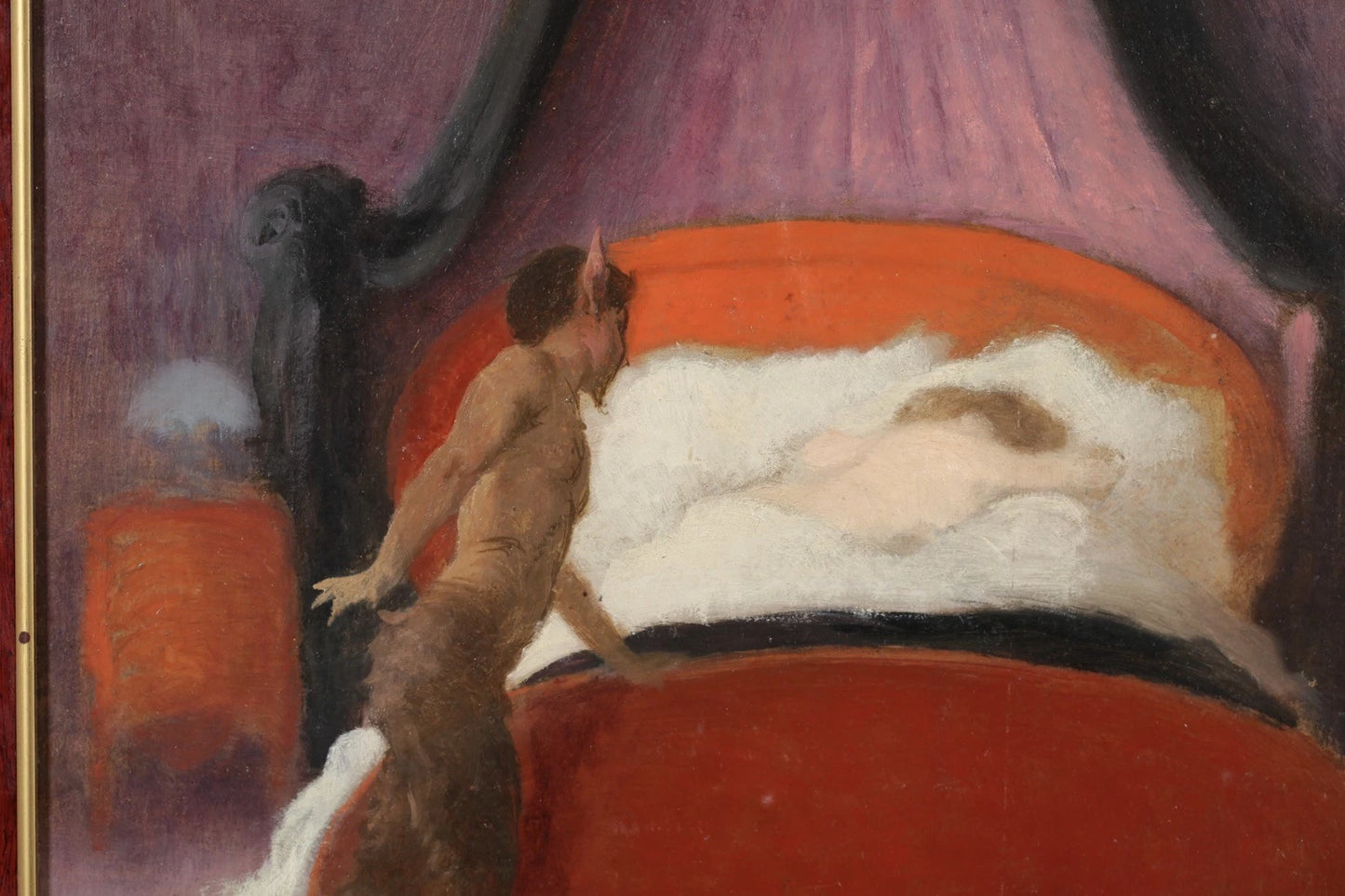
An oil on panel by Albert Joseph Pénot (French, 1862–1930): a sleeping nude with a satyr at her shoulder. Eighteen by thirteen and a half inches unframed.
Pénot is a painter of one subject. The female nude was, as his biography puts it, the implicit focus of his work, and he is best remembered now for the stranger end of it — La femme chauve-souris, the bat-woman of about 1890, which made £137,500 at auction in 2018, and Départ pour le Sabbat of 1910, a nude riding out to the witches’ sabbath. A satyr leaning over a sleeping woman belongs to exactly that register: mythological cover for something frankly erotic, which is what the Salon permitted and the market wanted.
The satyr is the licence. A nude alone was a nude; a nude with a satyr was a subject from antiquity, and the distinction mattered to what could be exhibited and sold. Pénot worked that seam for forty years with a soft, hazy handling of light that keeps the picture on the right side of the line.
The verso carries an invoice from Giafferi & Chambelland at the Hôtel Drouot, Paris, dated 1884. Drouot opened in June 1852 on the rue Drouot and was the hub of the Paris secondary market; French sales of the period ran under the monopoly of the commissaires-priseurs, the licensed officers whose names appear on the paperwork. The invoice is on the panel and can be read — we are describing what is physically there rather than offering an attribution of the sale.
Details
Oil on panel
Signed; titled “Satyr and sleeping nude”
18 × 13½ in unframed / 19 × 14½ in framed
Giafferi & Chambelland, Hôtel Drouot invoice to verso, dated 1884